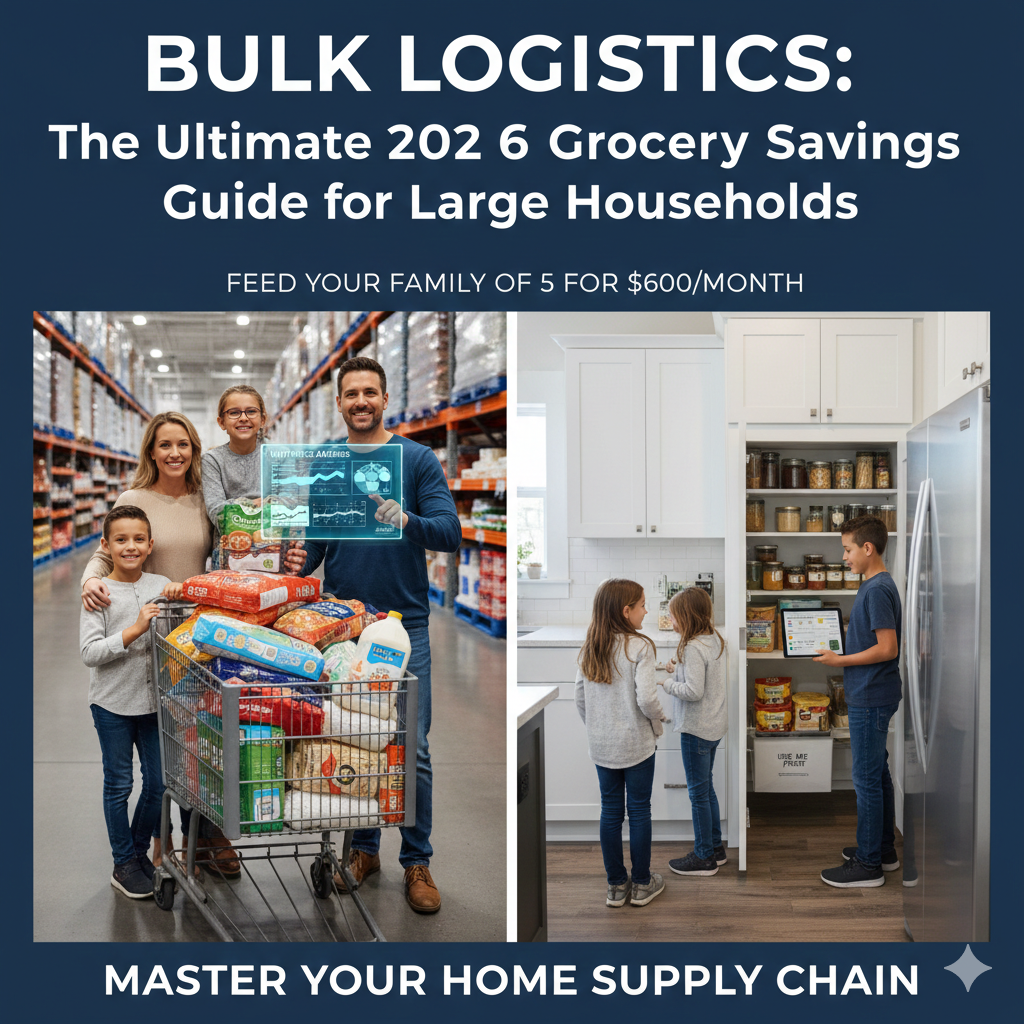
Feeding a family of five in 2026 is no longer a simple errand—it is a supply chain operation. With the average cost of groceries for a household of this size hovering between $1,200 and $1,600 per month, a “casual” approach to the supermarket is a recipe for financial leakage.
To win, you must shift your mindset from “shopping” to logistics. A family of five is effectively a small business that consumes over 5,000 meals and snacks a year. By applying professional inventory management and bulk acquisition strategies, you aren’t just saving pennies; you are reclaiming an average of $2,500 in annual food waste and redirected spending.
Data Point: According to recent consumer studies, the “convenience tax”—buying pre-cut, pre-packaged, or small-batch items—costs a family of five an additional $180 per month. Reclaiming that is your first step to a $2,000/year raise.
1. The Unit Price Masterclass
The most common trap in the grocery store is the “Sale” sticker. In 2026, retailers have mastered “shrinkflation,” where prices stay the same but volumes drop. To combat this, you must ignore the price on the tag and look exclusively at the Unit Price (price per ounce, gram, or sheet).
- The Stock-Up Price: Keep a “Price Book” (or a note in your phone) of the best unit prices for your top 10 staples (e.g., chicken breast at $2.99/lb, rice at $0.05/oz).
- The Bulk Illusion: Never assume the bigger box is cheaper. Sometimes two “Standard” sizes on sale beat one “Family” size at retail price.
- The Mathematics of Staples: For a family of five, buying a 20lb bag of rice vs. 2lb bags can reduce your cost-per-serving by over 400%.
Pro-Tip: If the shelf tag doesn’t list the unit price, use your phone calculator: Price / Quantity = Unit Cost.
2. Warehouse Club Optimization (Costco/Sam’s/BJs)
For a large family, a warehouse membership isn’t a luxury; it’s an essential tool—if used correctly. The goal is to avoid the “Treasure Hunt” trap where you spend $100 on items you didn’t need.
- The High-ROI Categories: Dairy, frozen fruits/vegetables, oats, oils, and rotisserie chickens. These items typically pay for the membership fee in under three months for a family of five.
- The Avoid List: Large boxes of highly-processed snacks. They have a high “grazing rate”—your family will eat them faster simply because they are there, negating the bulk savings.
- The Rotisserie Hack: At roughly $5.00, a rotisserie chicken is a “loss leader.” Use the meat for one dinner, and boil the bones for a gallon of high-quality stock for tomorrow’s soup.
Case Study: By switching five core staples (Milk, Eggs, Bread, Chicken, and Toilet Paper) to a warehouse club, the “Miller family” reduced their monthly spend by $115 without changing their diet.
3. Inventory Management: The FIFO Method
The biggest enemy of a $0-waste kitchen is “The Black Hole”—the back of your pantry where cans go to die. Professional kitchens use the FIFO (First In, First Out) method to ensure nothing expires.
- Rotate Your Stock: When you buy new cans or boxes, place them behind the existing ones.
- The “Use Me First” Bin: Place a small plastic bin in the fridge for items that are within 48 hours of spoiling (half an onion, wilting spinach, open yogurt).
- Digital Inventory: Use apps like KitchenPal or NoWaste to track what’s in your deep freezer so you don’t buy a third bag of frozen peas.
4. Strategic Meal Planning: The “Core 7” Method
The reason most meal plans fail is complexity. A family of five needs reliability. Instead of 30 different recipes, master 7 Core Base Meals that use overlapping ingredients.
- Overlap Ingredients: If Monday is Tacos and Wednesday is Taco Salad, you can bulk-prep 3lbs of seasoned ground meat and a massive head of lettuce once.
- The Sunday Prep Ritual: Spend 90 minutes on Sunday washing produce and portioning snacks. If it’s “ready to eat,” your family won’t reach for expensive pre-packaged alternatives.
- Decision Fatigue: Having a “Tuesday is Pasta Night” rule eliminates the mental load that often leads to $80 “emergency” takeout orders.
Contrarian Opinion: “Variety” is the enemy of the budget. Your family doesn’t need a new culinary experience every night; they need consistent, high-quality, high-protein meals that don’t break the bank.
5. Protein Scaling and Meatless Anchors
Protein is the most expensive line item for a family of five. To save, you must learn to “scale” your protein or use “anchors.”
- The “Half-Meat” Strategy: When making chili, tacos, or pasta sauce, replace 50% of the meat with lentils, black beans, or finely chopped mushrooms. It preserves the flavor profile while cutting the cost-per-gram of protein by 30%.
- Meatless Anchors: Dedicate two nights a week to high-satiety plant proteins like chickpea curry or black bean burgers.
- Caloric ROI: Focus on beans and eggs. One dozen eggs provides roughly 72g of protein for a fraction of the cost of a steak.
6. The Anti-Waste Kitchen: Preservation Tactics
If you buy in bulk but throw away 20% of it, you are losing money. Preservation is the final stage of grocery logistics.
- The Herb Bouquet: Store cilantro and parsley in a glass of water like flowers to triple their lifespan.
- Flash-Freezing: If berries or spinach are about to turn, spread them on a baking sheet, freeze them, then bag them for smoothies.
- The “Bread Resurrection”: Store bread in the freezer and only take out what you need. Stale bread can be turned into breadcrumbs or croutons, never thrown away.
7. Digital Stacking: Rebates and Loyalty Loops
In 2026, the savvy shopper “stacks” three layers of savings on every trip.
- Store Loyalty Apps: Clip digital coupons before you enter the store to avoid impulse-clipping.
- Rebate Apps: Scan your receipt into Ibotta or Fetch to get cash back on items you were already buying.
- Credit Card Rewards: Use a card like the American Express Blue Cash Preferred (6% back at supermarkets) and pay it off immediately.
Pro-Tip: Stacking a 6% cash-back card with a 10% digital coupon and a $1.00 Ibotta rebate can effectively reduce your bill by 20% or more.
Conclusion: The Compound Interest of Savings
Saving $300 a month on groceries isn’t just about the $3,600 you save this year. If you redirect that “grocery win” into a 529 College Savings Plan or an IRA, that $300/month becomes over $50,000 in a decade (assuming 7% returns).
Grocery shopping is the most frequent financial decision you make. Start today by choosing three “leaky” categories (like snacks, soda, or pre-cut meat) and switching them to bulk, whole-food alternatives. Your bank account—and your family’s health—will thank you.
Leave a Reply